The Probability of Messi and Yamal: A Bayesian Estimate

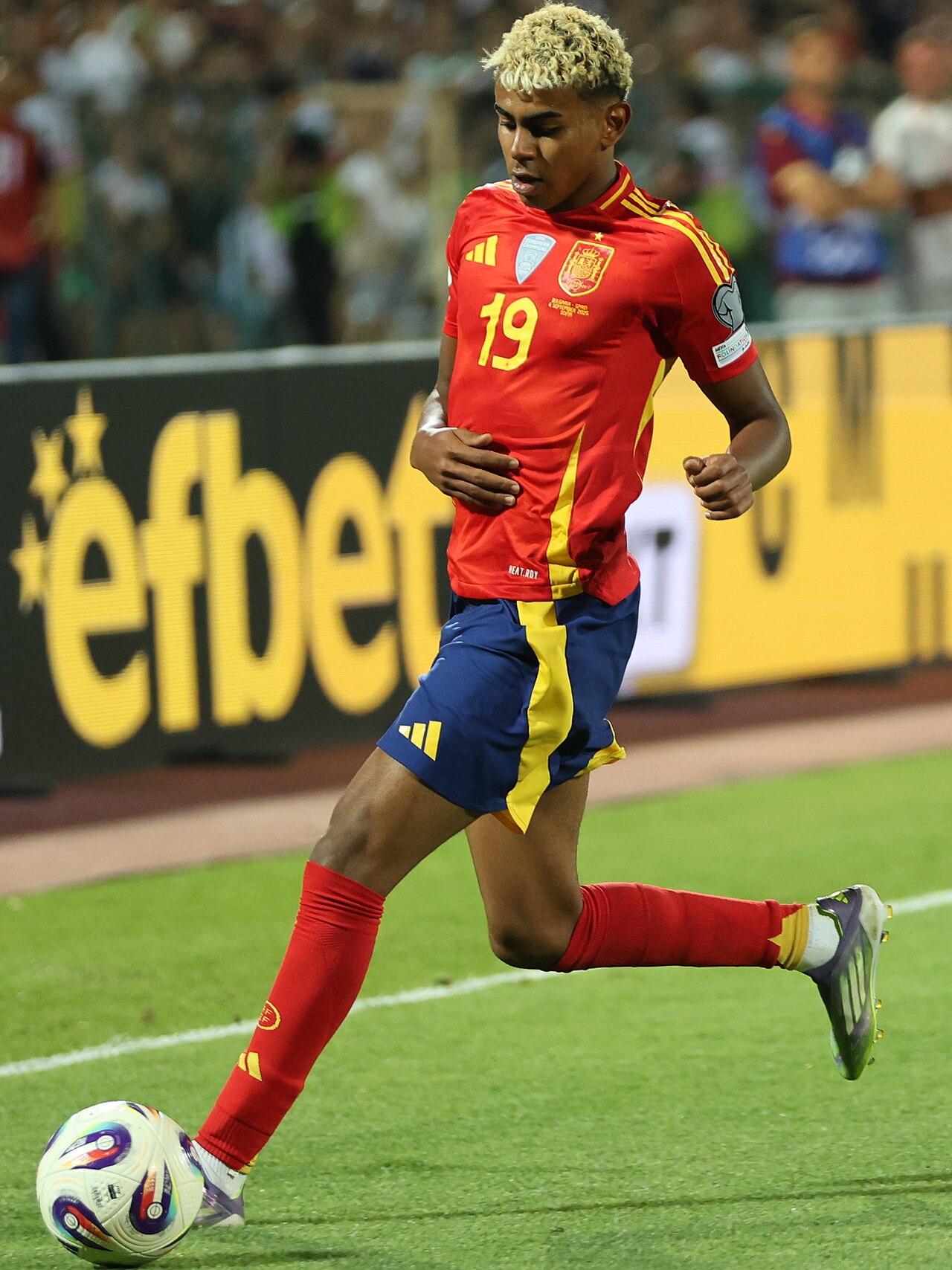
Messi in March 2007; Yamal in September 2025. Photos: Darz Mol, CC BY-SA 2.5 ES; Biso, CC BY 4.0; via Wikimedia Commons.

.jpg)
Ahead of Sunday’s World Cup final between Argentina and Spain, a 2007 photo of a twenty-year-old Lionel Messi bathing a baby in a blue tub has been circulating on social media. The baby is Lamine Yamal. It turns out his family had won a neighborhood charity raffle; the prize was a photo with a Barcelona player for a charity calendar. I’m sure from the popularity of the photo there have been many attempts at this calculation, but here is mine: judged from the moment the family entered that raffle in 2007, my estimate of the probability of everything that followed, through to this year’s final, is about 1 in 370 billion.
Ground rules
Vantage point. Every probability is conditioned on the autumn 2007 information state, the moment the family entered the charity raffle; call it \(\mathcal{I}\). Messi being a Barcelona first-team star is part of \(\mathcal{I}\); everything later is not.
The event. Five components, in order: Yamal’s family wins the raffle (\(E_{\text{win}}\)); the baby is photographed with Messi specifically (\(E_{\text{pair}}\)); Yamal is named to Spain’s squad for the 2026 World Cup (\(E_{\text{Yamal}}\)); Messi, at 39, is named to Argentina’s (\(E_{\text{Messi}}\)); Argentina and Spain meet in the final (\(E_{\text{final}}\)). Squad selection and the matchup only; whether either actually plays on Sunday is not part of the event.
Evidence. Conditioning is not the same as evidence. Time-stable rates (career longevity, teenage debuts, favorites reaching finals) may be estimated with data from any era, on one condition: the protagonists are excluded from every count. Yamal is left out of the teenager counts and Messi out of the longevity counts. What is forbidden is conditioning on this case’s own path.
The arithmetic. The target is one number,
\[ p = \Pr(E_{\text{win}} \cap E_{\text{pair}} \cap E_{\text{Yamal}} \cap E_{\text{Messi}} \cap E_{\text{final}} \mid \mathcal{I}), \]which the chain rule factors exactly, each factor conditioned on every event before it in that order, and every factor conditioned on \(\mathcal{I}\) throughout. Two modeling assumptions simplify the factorization. Winning a photo raffle has no causal path to a football career, so the squad events \(E_{\text{Yamal}}\) and \(E_{\text{Messi}}\) are modeled as independent of \((E_{\text{win}}, E_{\text{pair}})\) and of each other; the final is modeled as depending on the earlier events only through the squads. What remains is
\[ p = \Pr(E_{\text{win}}) \cdot \Pr(E_{\text{pair}} \mid E_{\text{win}}) \cdot \Pr(E_{\text{Yamal}}) \cdot \Pr(E_{\text{Messi}}) \cdot \Pr(E_{\text{final}} \mid E_{\text{Yamal}}, E_{\text{Messi}}). \]Why the last factor keeps its conditioning is explained in the section on the Argentina–Spain final. Each factor depends on a real unknown quantity: an entrant count, a calendar size, three historical rates. Each unknown gets a prior. Where a verified count exists, the prior is updated on it, and the posterior uncertainty is carried through to the final answer. The output is not a number but a distribution over the chain probability.
Rocafonda, 08304
Yamal’s family lived in Rocafonda, a neighborhood of roughly eleven thousand people in Mataró (Wikipedia), built in the 1960s for migrant workers from southern Spain. By the 2000s the migration had become international: about a third of residents were foreign-born, twice the Mataró average, and arrivals peaked between 2003 and 2007 (Barris i Crisi, 2014). The year Lamine was born there, the Generalitat designated Rocafonda–El Palau for rescue funding under the Llei de Barris (Ajuntament de Mataró).
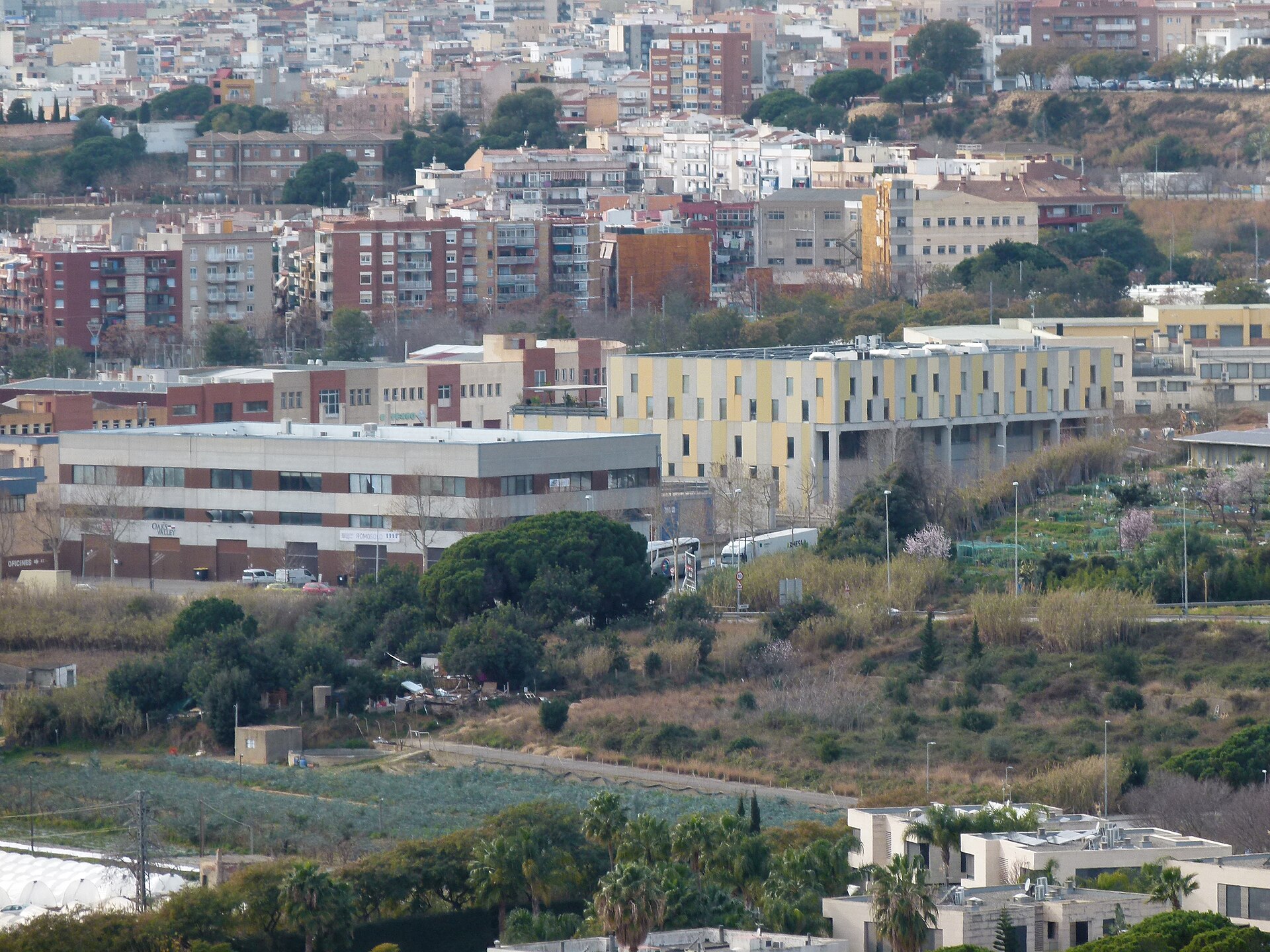
Rocafonda’s apartment blocks behind the Mata-Rocafonda industrial estate, photographed in 2025. Photo: Pere López Brosa, CC BY-SA 4.0, via Wikimedia Commons.

That autumn, the newspaper Sport, the Barça Foundation, and UNICEF produced their annual charity calendar, pairing first-team players with local children. UNICEF ran a raffle in Rocafonda through the charity programs it worked with; the family entered and won (ESPN/AP, 2024; Ara, 2024). No record survives of how many families entered. The size of Rocafonda and the reach of a neighborhood charity program suggest more than a few dozen, plausibly a few hundred. One agency account describes the pool more loosely as “Barcelona-area families”, which would make it larger; the prior’s long right tail covers that possibility. I treat the entrant count as an unknown with a wide prior rather than as a number to pretend to know.
The raffle factor comes out near one in a hundred.
The visitors’ locker room
The shoot happened on October 31, 2007, in the away dressing room of the Camp Nou (Ara Balears, 2026). The tub was Monfort’s idea, conceived the night before while bathing his own daughter (El Desmarque, 2026). The family did not choose their player. The organizers assigned the pairings; Monfort is explicit that “the photo could have been with another player,” and that the family would likely have picked Ronaldinho given the choice (EFE, 2026). The calendar had one player–child page per month, twelve pages in all (Ara Balears, 2026). No definitive roster survives, and published lists of the participating players conflict, but that conflict concerns who filled the pages, not how many pages there were. I take Messi, a first-team star in a calendar built on first-team players, to occupy exactly one page. With the count documented and nothing favoring one pairing over another, every page is equally likely; this is the one factor the model treats as known exactly.
One page in twelve.
The long shot
Spain registered 492,527 births in 2007; roughly 254,000 were boys (INE). The event requires this one boy to be on a specific 26-man squad nineteen years later, at age 18 or 19. Players that young are nearly absent from World Cup history: only eight have played a match before turning 18 (Opta, 2026). Attrition inside football is severe too. Among teenagers already in La Liga academies, a heavily pre-selected group, about 4% reach top-tier football at all (University of Essex, 2024), and Spain has capped 874 players in its entire history (RFEF).
The count that enters my model is simple. Across Spain’s seventeen World Cups, only five squad members have been aged 19 or younger on opening day, not counting Yamal, per the evidence rule: Fàbregas in 2006, Gavi, Balde and Pedri in 2022, and Cubarsí in 2026 (Wikipedia squad pages). All five come after 2000, in a series that starts in 1934, so the long-run average understates the modern rate, and the estimate is conservative. One more piece of 2007 information is admissible: this baby lives in greater Barcelona, in a football-obsessed family, which makes him more likely than a randomly drawn Spanish boy to become a footballer. Both effects are mild, so the model multiplies the base rate by an uncertain factor centered on two.
One assumption sits in this factor. The rate above, five teenagers in seventeen tournaments, counts only tournaments Spain played, so using it as \(\Pr(E_{\text{Yamal}})\) assumes Spain qualifies for 2026. In 2007 that was close to safe: Spain had been at eight straight World Cups (Wikipedia squad pages). Setting the qualification probability to 0.9 instead of 1 would move the headline number by about ten percent, small next to the width of the final interval. No such assumption is needed for Argentina. The next section estimates \(\Pr(E_{\text{Messi}})\) as the fraction of Messi’s 2006 peers who are in a 2026 squad. A player whose nation missed the tournament is not in any squad, so that fraction already includes the risk of failing to qualify.
Combined: about a third of an expected teenage slot per squad, spread over the roughly 508,000 boys in the two eligible birth years, times the factor of two.
About one in 760,000.
Thirty-nine
The photo’s other subject has his own long shot: the established twenty-year-old star must still be on his national squad nineteen years later, at 39. The list of outfield players who have appeared at a World Cup at 39 or older fits on two hands (Guinness World Records), and only two men have ever appeared in six World Cups: Messi and Ronaldo (Wikipedia).
The count that enters my model comes from Messi’s own cohort: the 28 players aged 20 or under, across all 32 squads, at the 2006 World Cup. Twenty-four were outfield players, including Wayne Rooney, Sergio Ramos and Cesc Fàbregas; four were goalkeepers. Leave Messi out, and exactly one of the remaining 23 outfielders is in a 2026 squad: Luka Modrić (Wikipedia squad pages). I exclude the goalkeepers because they age on a different curve, and the cohort shows it: one of the four, Guillermo Ochoa, is also in a 2026 squad. If the rate errs, it errs low: Messi in 2007 was already more established than the median member of that cohort, and established players plausibly last longer.
Combined: one success in 23 trials, plus the half success and half failure the prior contributes, is 1.5 in 24.
About one in sixteen.
The final
The last factor, \(\Pr(E_{\text{final}} \mid E_{\text{Yamal}}, E_{\text{Messi}})\), keeps its conditioning because the squad events carry information about the teams: if Argentina keep a 39-year-old on merit and Spain carry a teenager, both squads are probably elite; nobody carries either as a favor. So the question becomes how often a top side reaches a given final. In the betting-market era, 1966 through 2022, the pre-tournament favorite reached the final in four of fifteen tournaments (SportsOddsHistory). Updating the prior, which contributes one success and two failures, on that record gives 5/18 per team, slightly more than one in four. Both teams must do it at once. In opposite halves of the bracket their runs never cross before the final, so I treat the two as independent and multiply: 5/18 squared, about one in thirteen. Last, the draw itself: the finalists are the winners of the bracket’s two halves, so a specific pair can meet in the final only if the draw separates them, and that happens about half the time. Halving one in thirteen gives the factor. Two checks are consistent with it. The top two favorites have never once both reached a final, zero for fifteen, which fits a probability of this size (SportsOddsHistory). And as a sanity check only, since 2026 information is not admissible: the pre-tournament markets priced exactly this final near 5% (Fox Sports, 2026; Silver Bulletin, 2026).
About one in twenty-six.
The model
Five unknowns, five priors: three updated on verified rate counts, one collapsed onto a documented page count, one left as elicited:
| Factor | Prior | Data (protagonists excluded) | Posterior mean |
|---|---|---|---|
| \(\Pr(E_{\text{win}})\): raffle win | entrants \(N \sim\) LogNormal, 90% mass in [30, 1000] | none exists | 1/98 |
| \(\Pr(E_{\text{pair}} \mid E_{\text{win}})\): paired with Messi | pages \(K \sim\) Uniform\(\{10,\dots,14\}\) | 12 monthly pages (Ara Balears) | 1/12 |
| \(\Pr(E_{\text{Yamal}})\): on Spain’s 2026 squad | teenage-slot rate \(\lambda \sim\) Gamma(1, 2); 2007-knowable boost \(\sim\) LogNormal(ln 2, 0.35) | 5 teenagers in Spain’s 17 World Cups (squad pages) | 1/760,000 |
| \(\Pr(E_{\text{Messi}})\): on Argentina’s 2026 squad | survival \(q \sim\) Beta(½, ½) | 1 of 23 outfield 2006 U21s reached 2026 (squad pages) | 1/16 |
| \(\Pr(E_{\text{final}} \mid E_{\text{Yamal}}, E_{\text{Messi}})\): Argentina–Spain final | elite-reaches-final rate \(r \sim\) Beta(1, 2); ×½ for opposite halves | favorite reached final 4 of 15, 1966–2022 (SportsOddsHistory) | 1/26 |
What the data did: priors (dashed) and posteriors (solid) for the three rate-updated factors.
Posterior means; the conditioning structure is stated in the ground rules.
Propagation is by Monte Carlo: sample every unknown from its posterior, multiply the five factors, repeat two million times. The whole model is twenty lines of NumPy.

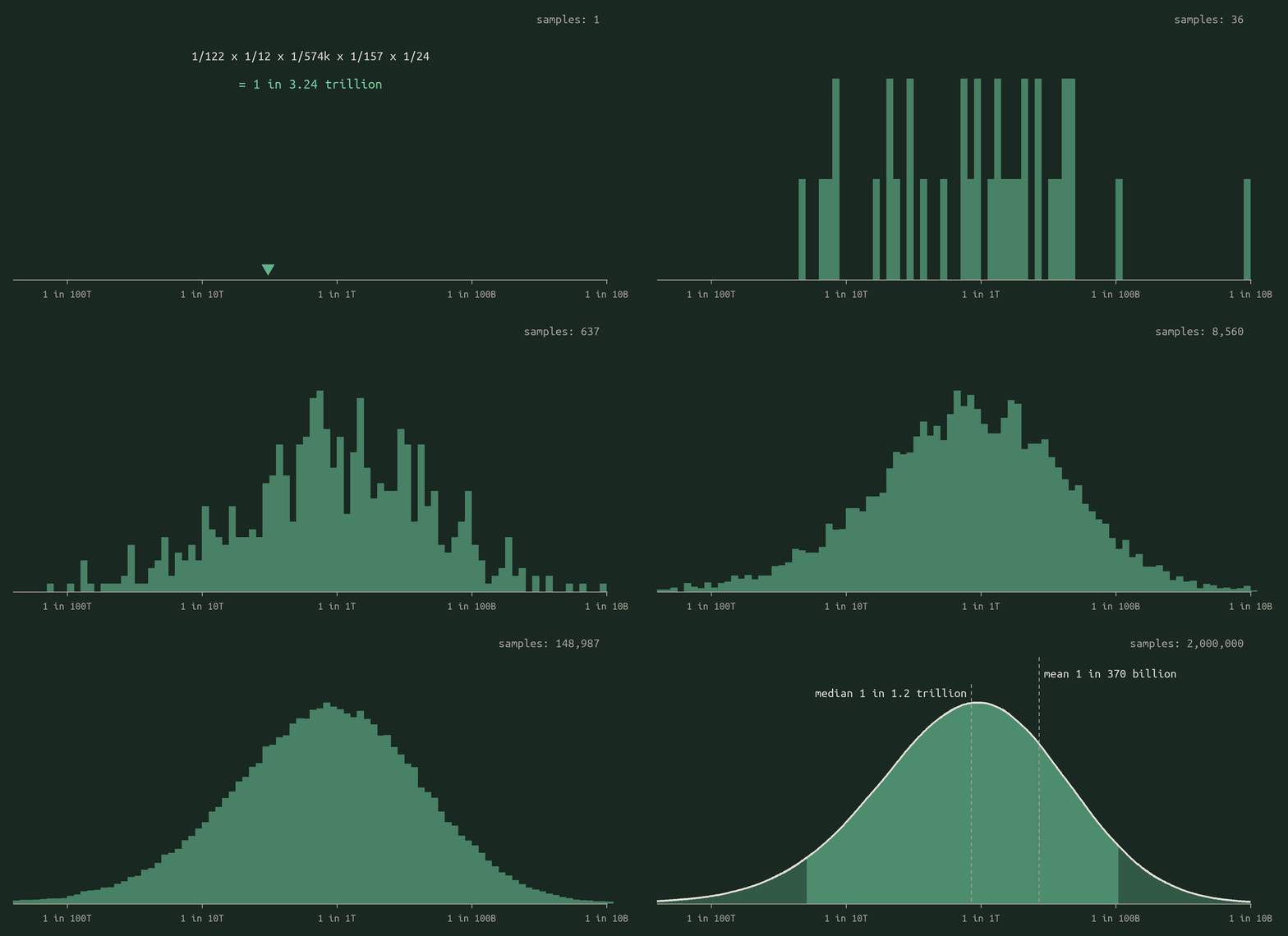
Each sample is the product of one draw of each factor; two million samples give the posterior.
The posterior mean of \(p\), 1 in 370 billion, is the predictive probability of the event. Odds are \(p/(1-p)\), so the odds were 370 billion to one against, and at this magnitude the distinction is invisible. The distribution is right-skewed on the probability scale, which is why the median sits lower, near one in 1.2 trillion. Ninety percent of the posterior lies between one in 20 trillion and one in 90 billion.
Disagree with a factor? Each slider below spans that factor’s 90% interval (for the pairing factor, fixed at one in twelve, the span of its prior); the product updates as you move it.
The shaded band on the axis is the joint 90% credible interval from the Monte Carlo.
The category of the event
That number answers one question: this baby, this player, this final. A Bayesian should immediately ask about the reference class: what is the probability that some photo like this exists, some star holding some stranger’s baby who grows up to face him?
Top-flight European clubs run charity calendars, hospital visits, and mascot programs continuously; the five big leagues alone stage on the order of tens of thousands of player–child encounters every year (Premier League; Real Madrid Foundation). Two decades of that is millions of photographs. Even if each photographed boy reaches top-flight football with a probability of one in a few thousand, the expected number of future professionals already sitting in those photos runs to the hundreds. That some of them will one day share a pitch with the star from their childhood photo is not a miracle; it is close to a certainty.
These numbers answer different questions, and choosing the question is choosing the reference class. What stays genuinely rare even at the category level is everything this particular case stacked on top: the child became not merely a professional but the best of his generation, and the reunion is a World Cup final.
Coda
Kickoff is Sunday, 3 p.m. Eastern, at MetLife Stadium (Wikipedia). As I finish this post, that’s two hours away. The baby in the tub turned 19 last week; the man who held him is 39. The event I priced ended at squad selection and the matchup, but I’ll be watching like everyone else.
References
[1] “Rocafonda.” Wikipedia. en.wikipedia.org
[2] “Rocafonda-El Palau (Mataró) i el repte de superar la ciutat trencada.” Barris i Crisi, Universitat Autònoma de Barcelona, 2014. barrisicrisi.wordpress.com
[3] “La Llei de Barris, un nou impuls per a Rocafonda-El Palau.” Ajuntament de Mataró. mataro.cat
[4] “The story behind photos of Lionel Messi and baby Lamine Yamal.” ESPN / Associated Press, July 10, 2024. espn.com
[5] “La historia curiosa y premonitoria de la foto de Leo Messi y Lamine Yamal.” Ara, July 10, 2024. es.ara.cat
[6] “The story of the ‘impossible photo,’ explained by the one who organized it.” Ara Balears, July 16, 2026. en.arabalears.cat
[7] “Joan Monfort, el fotógrafo de Messi y Lamine Yamal.” El Desmarque, July 16, 2026. eldesmarque.com
[8] “La revelación de Joan Monfort: ‘Podría haber sido con otro jugador.’” Canal 26 / EFE, July 16, 2026. canal26.com
[9] “Movimiento Natural de la Población 2007.” Instituto Nacional de Estadística. ine.es
[10] “The youngest players in FIFA World Cup history.” The Analyst / Opta. theanalyst.com
[11] “Just four per cent of teenage academy players make it to top-tier football.” University of Essex, June 2024. essex.ac.uk
[12] “Futbolistas de la selección de fútbol de España.” Wikipedia. es.wikipedia.org
[13] “FIFA World Cup squads,” per-tournament pages (1934–2026), with player birthdates. Wikipedia. Counts verified from the squad tables; e.g. 2006, 2026
[14] “Oldest outfield player in a FIFA World Cup.” Guinness World Records. guinnessworldrecords.com
[15] “List of players who have appeared in the most FIFA World Cups.” Wikipedia. en.wikipedia.org
[16] “World Cup pre-tournament odds, 1966–2022.” SportsOddsHistory. covers.com
[17] “World Cup 2026 champion odds.” Fox Sports, June 2026. foxsports.com
[18] Nate Silver. “World Cup 2026 odds and predictions.” Silver Bulletin, June 2026. natesilver.net
[19] “Premier League clubs spread Christmas cheer at hospital visits.” Premier League, December 2023. premierleague.com
[20] “La Fundación Real Madrid reparte ilusión a más de 1.500 niños y niñas.” Real Madrid, January 2025. realmadrid.com
[21] “2026 FIFA World Cup final.” Wikipedia. en.wikipedia.org